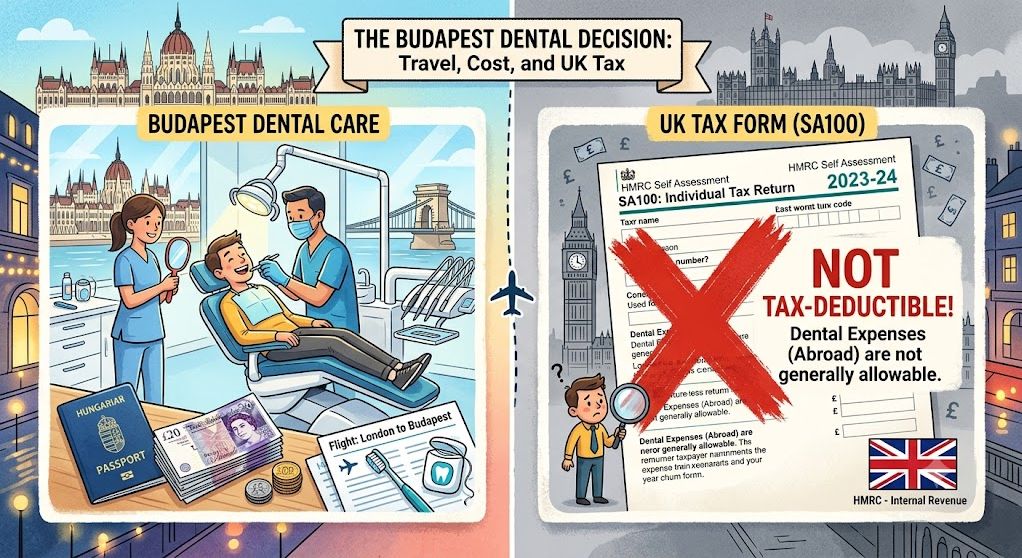
For most UK residents, dental work in Budapest is not tax deductible in the UK in the way many people imagine, and there is no general HMRC scheme that lets you claim back the cost of overseas implants or cosmetic dentistry as a simple “medical expense.” What you can and cannot claim depends on your personal status (employee vs. self‑employed), the nature of the treatment (medical vs. cosmetic), and whether the cost is wholly, exclusively and necessarily incurred for your work—which almost all private dental tourism is not.
Why UK Patients Think Budapest Dental Is Tax Deductible
Budapest’s reputation for affordable, high-quality dental work has led many UK and Irish patients to combine treatment with a short city break, and online forums often mention “tax back” or “claiming medical expenses abroad.” In Ireland, for example, Revenue allows tax relief on qualifying non‑routine dental expenses abroad via the MED 2 system, including treatment in Budapest.revenue+5
This Irish framework has created confusion among UK readers: they see Irish case studies claiming dental expenses abroad and assume similar relief exists via HMRC. In reality, the UK tax rules are different, and the broad medical expense reliefs that exist in some other countries are not available to most UK individuals.
HMRC’s Approach to Medical and Dental Expenses
Unlike some tax authorities, HMRC does not offer a general, simple “medical expenses” tax credit for individuals, regardless of whether care is in the UK or abroad. Tax relief in the UK typically arises only when an expense is linked to employment or self-employment and meets the test of being “wholly, exclusively and necessarily” incurred for the purposes of that trade or employment.
Applied to dental tourism:
-
Private dental treatment for personal health or appearance—even if medically necessary—is usually a personal expense, not deductible against income.
-
There is no standard HMRC form equivalent to Ireland’s MED 2 that reimburses UK taxpayers for overseas dental costs.
-
Cosmetic procedures designed mainly to improve appearance (veneers, whitening, smile makeovers) are treated as lifestyle choices, not tax-deductible medical expenditure.
In short, saving money by travelling to Budapest is still a private decision; the UK tax system does not typically contribute to those savings.
Specific Misconceptions UK Patients Have
Dental tourism marketing and forum posts often sow misunderstandings that UK taxpayers should be careful about. Common misconceptions include:
-
“If my treatment is medically necessary, HMRC will give me tax relief.”
In practice, HMRC does not operate a general personal medical expense relief scheme, so even medically necessary crowns or implants abroad do not automatically generate a deduction. -
“I can claim back Budapest dental costs like Irish patients do with MED 2.”
MED 2 is an Irish Revenue mechanism; UK residents cannot use it, and HMRC has no identical system. -
“If I’m self-employed, I can put my dental trip through my business.”
To be allowable, the cost must be wholly and exclusively for the business. Personal dental care, even if it helps you present better to clients, is usually considered dual‑purpose (personal and business) and disallowed. -
“Travel and accommodation linked to treatment are medical expenses I can deduct.”
In the UK, travel and accommodation for personal medical care are also personal costs; they do not become deductible simply because they are associated with health treatment.
Understanding these points helps UK readers avoid planning trips around tax relief that does not exist.
Edge Cases: When Tax Relief Might Be Relevant
There are narrow scenarios where tax or medical expense frameworks touch dental tourism—but they are exceptions rather than the rule.
Examples include:
-
Employer-sponsored treatment: In rare cases, an employer may fund medical or dental interventions directly; the tax treatment depends on complex benefit-in-kind rules and professional advice.
-
Specialist relief for disabled or chronically ill people: Certain disability-related adjustments or equipment can attract relief, but this is different from standard dental tourism for implants or aesthetic work.
-
Non‑UK systems: Irish and some other tax authorities allow relief on non‑routine dental expenses abroad, provided certain conditions are met, but those systems apply to their own taxpayers, not UK residents.
For typical UK residents paying out of pocket for a Budapest dental package, none of these edge cases applies, so no straightforward UK tax deduction is available.
Comparing Ireland’s MED 2 Relief vs. UK Reality
Because Budapest is a key hub for Irish and UK dental tourists, it’s useful to contrast Irish MED 2 relief with UK rules.
In Ireland:
-
Non-routine dental treatment—such as crowns, bridges, and implants—can qualify for tax relief, including when done abroad in Budapest, if the dentist is properly registered.
-
Patients must obtain detailed receipts and a MED 2 form signed by the treating dentist and submit these to Revenue, often via the online ROS system.
In the UK:
-
There is no MED 2 equivalent; there is no standard mechanism for claiming private dental costs abroad as tax-relievable medical expenses.
-
Dental tourism remains a private consumer decision with no automatic linkage to HMRC relief.
This comparison is key for UK readers: you can clearly explain that Irish case studies do not translate into UK tax rights.
The Real Financial Picture: Budapest Savings Without UK Tax Support
Budapest dental clinics and travel agencies highlight savings of up to 50–70% versus UK private prices for implants and full-mouth reconstructions. Those savings are driven by lower local overheads, wage levels, and package efficiencies, not by UK tax incentives.
Typical cost structure for a UK patient:
You can still achieve meaningful savings by choosing Budapest over UK private treatment, but all costs are paid from post-tax income under current UK rules.
Practical Guidance for UK Readers
For UK-focused dental tourism content, it’s useful to give clear, practical advice rather than just legal theory.
Key points to include:
-
Budget on the assumption that you will not receive UK tax relief on Budapest dental costs.
-
Compare the full trip cost (treatment, flights, hotels, food, insurance) to UK private quotes to understand true savings.
-
Do not rely on hearsay from forums or overseas marketing suggesting “simple tax refunds” for UK residents—they often refer to Irish or other systems.
-
If you believe you fall into a special category (e.g., employer-funded treatment or complex health circumstances), speak to a qualified UK tax adviser before assuming any deduction.
This approach keeps expectations realistic and builds trust with UK readers who may be suspicious of overly optimistic claims.
Final Takeaway: Budapest Dental Is Usually Not Tax Deductible for UK Residents
For UK residents, dental work in Budapest—including implants, crowns, veneers, and smile makeovers—is generally a private, non-deductible expense under current HMRC rules. There is no widespread UK tax relief system equivalent to Ireland’s MED 2, and travel, accommodation, and subsistence linked to treatment remain personal costs.
The financial case for Budapest remains strong for many patients, but it stands on price differences and clinic quality—not on UK tax rebates. Explaining this clearly helps UK readers plan realistically and avoid disappointment or compliance issues later.
FAQ: Budapest Dental Work and UK Tax Rules
Q1: Is dental work in Budapest tax deductible for UK residents?
A1: In most cases, no. For UK taxpayers, dental treatment in Budapest is treated as a private, personal expense. There is no general UK scheme that allows you to claim back the cost of overseas dental work—implants, crowns, veneers, or cosmetic smile makeovers—as a simple “medical expense” against your income tax.
Q2: Can I claim my Budapest dental costs as medical expenses on my UK tax return?
A2: Typically you cannot. The UK tax system does not offer a broad personal medical expense relief like some other countries do. Dental tourism is considered a personal healthcare and lifestyle choice, so the fees you pay to Budapest clinics are not normally deductible for UK tax purposes.
Q3: Are flights and hotels for Budapest dental trips tax deductible in the UK?
A3: No. Travel, accommodation, meals and other trip costs related to dental treatment abroad are regarded as personal living expenses. They remain non‑deductible even if the treatment is medically necessary, because they are not incurred wholly and exclusively for any UK trade or employment.
Q4: Can self‑employed UK residents put Budapest dental treatment through their business?
A4: Almost always no. For an expense to be allowable for a self‑employed person, it must be wholly and exclusively for the business. Personal dental care—whether for comfort, health or appearance—has a clear personal element, so it fails this test and is normally disallowed as a business expense.
Q5: I’ve seen Irish patients claim tax relief on dental work in Budapest. Does that apply to UK residents?
A5: No. Ireland has its own medical expense and dental relief rules, including specific forms that allow Irish taxpayers to claim back part of qualifying non‑routine dental costs abroad. Those rules apply only to Irish tax residents. UK residents cannot use Irish forms and do not receive the same relief under UK tax law.
Q6: Are any Budapest dental expenses ever tax‑relievable for UK patients?
A6: Only in very niche situations. In rare cases, employer‑funded treatment or disability‑related adjustments may interact with specific tax rules, but this is very different from standard dental tourism. Most UK residents paying out of pocket for private treatment in Budapest should assume no UK tax relief unless a qualified UK tax adviser confirms an exception for their circumstances.
Q7: Does NHS status or waiting list frustration affect tax deductibility?
A7: No. Whether you choose Budapest because you cannot access NHS dental care or because UK private prices are too high does not change the tax treatment. The fact that you needed treatment or struggled to get it on the NHS does not create a new tax relief for overseas dental costs under current UK rules.
Q8: Can I claim Budapest dental costs if my treatment is reconstructive rather than cosmetic?
A8: From a tax perspective, the distinction between reconstructive and cosmetic is not usually decisive. Even medically necessary implants or full‑mouth reconstructions are treated as personal healthcare costs for UK tax purposes. They may be clinically essential, but that does not make them tax‑deductible in the UK system.
Q9: Do I need to keep receipts for Budapest dental treatment for tax purposes in the UK?
A9: It’s wise to keep detailed invoices and treatment plans for your own records and for any future clinical follow‑up in the UK. However, for most UK residents these receipts will not be used to claim tax relief. Keep them for medical, insurance and aftercare reasons rather than expecting a tax refund.
Q10: What’s the best way for a UK resident to think about the cost of Budapest dental work?
A10: Treat Budapest dental treatment as a private purchase paid from after‑tax income. Compare the full cost of the trip—clinic fees, flights, hotels, food and insurance—to UK private quotes, without assuming any UK tax deduction. If the overall package still represents a saving and meets your clinical needs, it may be worthwhile, but tax relief is not part of the equation.
Sources
- Medical Tourism Tax Deductions: Country-by-Country Guide
- Claiming Irish Tax Relief for Dental Expenses Abroad (MED 2)
- Revenue (Ireland): Dental Expenses Relief
- Citizens Information: Tax Relief on Medical Expenses (Ireland)
- Dental Treatment Europe: Dental Tourism from Ireland to Hungary
- Body Expert: Dental Tourism in Hungary
- Budapest Dental: All-Inclusive Dental Holiday Packages
- AskAboutMoney Forum: Tax Back on Dental Treatment Abroad
- Hive Business: A–Z of Tax Deductible Expenses for Dental Associates